 +86 15338350382

 English
 Spanish
 French
 Russian
 Italian
 German
 Japanese

 10 min readPublished Sep 16 2026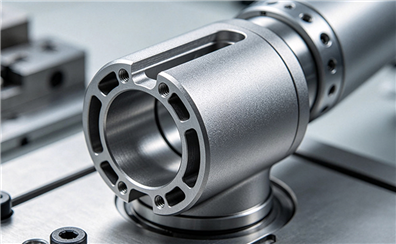
Introduction
With the rapid advancement of industrial robots, collaborative robots, humanoid robots, and autonomous mobile robots (AGV/AMR), robotics manufacturers are placing ever-increasing demands on the machining capabilities and supply stability of precision components. Whether it's a joint transmission component, a structural load-bearing part, or an end-effector, every robot component directly impacts the machine's motion accuracy, reliability, and service life.
CNC machining has become the core manufacturing process for robot components, owing to its high precision, high repeatability, and broad material compatibility. As an ISO 9001-certified precision manufacturer, Alcro specializes in providing customized CNC machining services for the robotics industry—from prototype development to volume production. This article explores the common types of CNC-machined robot components, key machining considerations, and how Alcro's expertise empowers the robotics industry.
Why Do Robot Components Require CNC Machining?
Precision is the Lifeline of Robotics
A robot's motion precision begins with mechanical precision. A deviation of just a few microns in a joint can propagate through the kinematic chain, resulting in errors of several millimeters at the end-effector. Control software and sensors can only compensate for physical errors to a limited extent—if the components themselves drift, bend, or misalign, no algorithm can fully restore performance. This is why critical robot parts such as joint connectors, shafts, bearing housings, and end-effector interfaces typically require micron-level dimensional tolerances.
Rapid Iteration and Customization
Robot development rarely follows a straight path from design to production. Engineers frequently adjust arm lengths, joint stiffness, motor interfaces, and tool layouts during system testing. CNC machining translates these design changes into physical parts quickly, without the long lead times of mold development.
Whether it's a single prototype or a small batch for validation, CNC machining meets R&D needs with the shortest possible turnaround.
Material Versatility
Robot components must balance lightweight construction with high strength. CNC machining handles a wide range of materials—from aluminum alloys (6061, 7075) and stainless steel (304, 17-4PH) to titanium alloys and engineering plastics (POM, PEEK).
Different materials serve different functions: high-strength aluminum alloys for structural load-bearing parts, stainless steel for wear-resistant transmission components, and engineering plastics for lightweight non-load-bearing parts.
Common CNC-Machined Robot Components
1. Structural and Load-Bearing Components
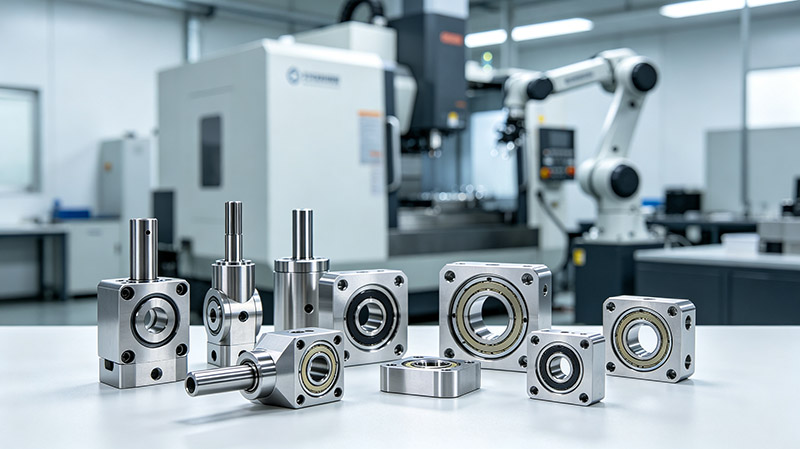
Typical components: Joint housing, motor housing, reducer housing, structural support, robot base and mechanical arm.
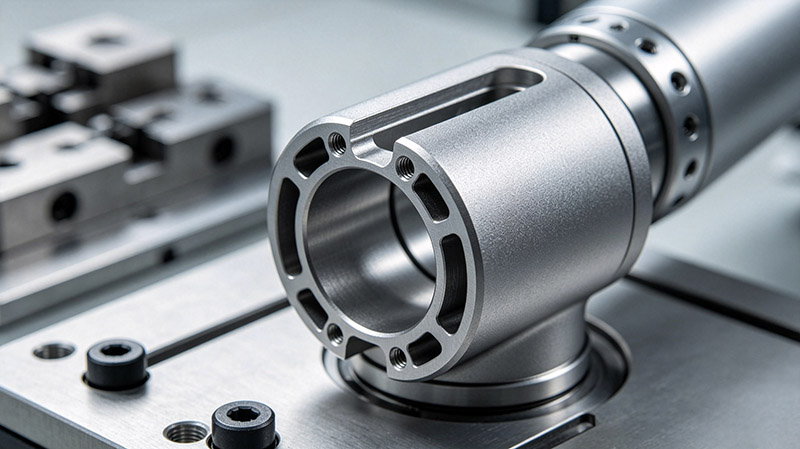
These components form the "skeleton" of the robot and bear the structural load of the entire machine. The processing focus includes rigidity, positional accuracy and assembly consistency. Taking the joint housing as an example, many are made of 7075 high-strength aluminum alloy, with the wall thickness possibly being less than 3mm, which is a typical thin-walled structure.
During processing, special attention needs to be paid to deformation control - optimizing the tool path, using conformal soft support fixtures, and controlling the clamping force, in order to keep the deformation within 0.05mm.
2. Motion and Transmission Components
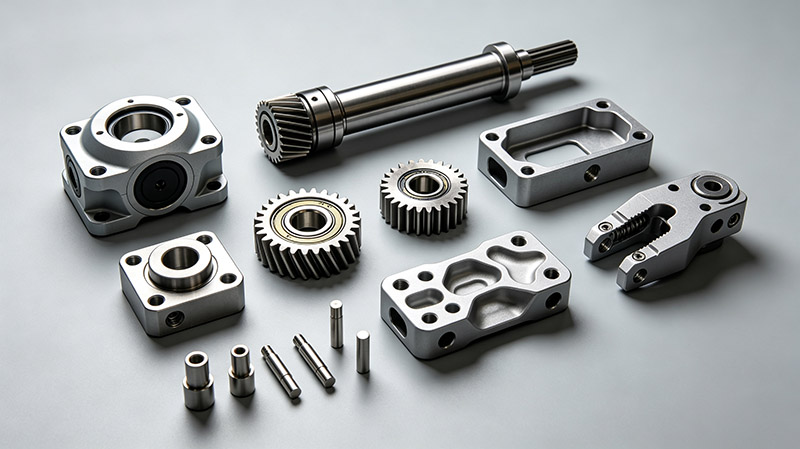
Typical Parts: Output shafts, joint shafts, couplings, precision sleeves, gears, and planetary gear sets
Transmission parts directly determine a robot's motion accuracy and dynamic response. Key machining concerns include concentricity, surface finish, and fatigue life. For a robot joint output shaft, diameter tolerances typically need to meet h6/h7 grade, concentricity controlled within 0.005-0.01mm, and surface roughness reaching Ra 0.4-0.8μm. Core components such as the rigid gears and end caps of harmonic reducers also demand extremely high machining precision.
3. Mounting and Connection Components
Typical Parts: Motor mounts, bearing housings, connecting shafts, locating pins, transmission bases, support blocks, sensor brackets, and camera mounts
While relatively simpler in structure, these parts ensure precise positioning and reliable connection between functional modules. The flatness and parallelism of mounting surfaces, along with the positional accuracy of holes, directly impact the assembly precision of motors, sensors, reducers, and other core components.
A deviation in a single locating pin can prevent an entire joint module from assembling properly.
4. End-Effectors and Custom Tooling
Typical Parts: End-effector bodies, custom grippers, robot-specific fixtures, calibration tools, and alignment jigs
The end-effector is the part of the robot that directly interacts with the workpiece, and its precision and reliability directly affect operational quality. Many teams use CNC machining to produce custom robot fixtures and calibration tools to aid assembly and maintenance. These parts typically require highly customized designs based on specific application scenarios.
5. Lightweight Structural Components
Typical Parts: Aluminum alloy robotic arms, thin-wall brackets, topology-optimized integrated structures
To reduce inertia and improve response speed, modern robots extensively employ lightweight designs. Thin-wall and topology-optimized structures present significant machining challenges—uneven material removal can lead to uneven release of internal residual stresses, causing part deformation. Machining strategies include symmetrical toolpaths, low-depth-of-cut stable cutting parameters, and custom fixtures to prevent deformation.
How Alcro Provides Professional CNC Machining for Robot Components
Multi-Axis Machining Capabilities
Alcro is equipped with 3-axis, 4-axis, and 5-axis CNC machining centers, capable of handling everything from simple brackets to complex contoured parts. For complex robot components such as joint housings and integrated joint modules with multiple angles and mounting faces, 5-axis machining enables complete multi-face machining in a single setup, significantly improving precision and consistency. Each repositioning introduces 0.005-0.008mm of datum offset, and cumulative errors from multiple setups can exceed 0.03mm—5-axis machining fundamentally eliminates this issue.
Rigorous Quality Control
Alcro implements strict quality control processes for every robot component. Starting with DFM (Design for Manufacturability) analysis, our engineers optimize designs before machining begins. After machining, every batch undergoes full CMM (Coordinate Measuring Machine) inspection, with first-article inspection reports and material certificates provided. Standard tolerance capability reaches ±0.05mm or better, with tighter tolerances available for high-end robot applications.
Flexible Production Volumes
The robotics industry requires support across the full lifecycle—from prototype validation to low-volume production to volume supply. Alcro's no-MOQ policy enables flexible response to single-piece prototypes and low-volume production needs. Whether it's a few samples for R&D or thousands of parts for production, Alcro delivers consistent quality assurance.
Extensive Material and Finishing Experience
Alcro has extensive experience machining aluminum alloys (6061, 7075), stainless steel (304, 17-4PH), titanium alloys, and various engineering plastics. A range of surface finishing options—including anodizing, sandblasting, and passivation—are available to meet the corrosion resistance, wear resistance, and aesthetic requirements of robot components.
Conclusion
Every advancement in the robotics industry relies on the solid foundation of precision manufacturing. From thin-wall machining of joint housings to micron-level precision control of transmission shafts, every robot component represents the pursuit of manufacturing excellence.
Alcro specializes in precision CNC machining, combining ISO 9001-certified quality systems, multi-axis machining equipment, a professional engineering team, and flexible production capabilities to serve as the most trusted custom parts machining partner for the robotics industry. Whatever stage of robot development you're in—from proof-of-concept prototypes to production delivery—Alcro delivers professional, efficient, and reliable customized CNC machining solutions.
Ready to bring your robot component designs to life? Contact Alcro today and let our professional team provide end-to-end service—from DFM analysis to finished part delivery.



 sophia@alcrocn.com
 +86 15338350382
 6th North Street, Xiagang Community, Chang'an Town, Dongguan City, Guangdong Province, China.
